Tuesday, June 11, 2013

The Mast Tree Riots of 1734

by Barbara Rimkunas

This "Historically Speaking" column appeared in the Exeter News-Letter on Friday, June 7, 2013.

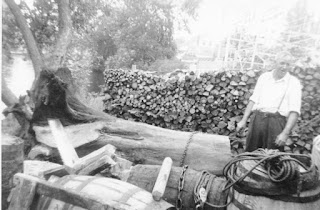
Lumber was so important to Exeter’s early residents that it was used in place of money. It was common for debts to be paid in barrel staves. So it’s no wonder that people considered trees the most valuable asset in town, considering they grew here for free and were, in the words of one historical society volunteer, “like thousand dollar bills sprouting from the ground.”

To the British government, New England’s towering pine trees were perfect for masts on his majesty’s naval vessels. In 1705, an Act was passed reserving the largest trees for the King’s Navy. A Surveyor General was appointed to locate any trees measuring larger than 24 inches at one foot from the base. These trees were then marked with three strokes of a hatchet that produced a pattern called the broad arrow. Locals were not allowed to cut these huge trees, the work was done by a local contractor who would find a crew to cut the tree, trim it and haul it to the nearest port. The contractor was also in charge of producing or improving long straight roadways to transport the trees. Exeter, like many towns, had a road that was called the “Mast Way” (later called “Lane’s End” and “Katy’s Lane,” today the old Mast Way is Park Street). 

New Englanders resented the act and most would at some point just get fed up and cut the tree down. The boards cut from it would be milled down to less than 24” in width; the owner made a small fortune and no one was the wiser. At least, that’s how things went for nearly 40 years. No one asked a lot of questions.

But there’s always that one guy – probably the same one who used to ask the teacher if there was any homework – who couldn’t shake the feeling that someone somewhere was getting away with something. That man, in 1734, was the Lieutenant Governor David Dunbar. Dunbar was also the Surveyor General and he was convinced (probably rightly) that the people of Exeter were cheating on the 24 inch rule. He trudged out to the Copyhold Saw-mill in a part of Exeter that would later become Brentwood. While he was on the road, the local lumbermen caught wind of his plans and greeted him with shouts and gunfire to scare him off. Dunbar made a hasty retreat, fearing for his life.

More convinced than ever, he returned to Portsmouth and hired a motley gang of ten men to sail up the Squamscott to do his dirty work. They arrived on the evening of April 23rd, checked into Simon Gilman’s tavern on Water Street and began drinking the night away. Loosened up with ale, the men bragged about their errand. Gilman then told them that the local men had taken up a collection and hired some Indians to murder Dunbar and two of his associates as soon as they left in the morning for the Black Rocks mill. Gilman was bluffing, but they didn’t know that.

Meanwhile, the local men were meeting at Gidding’s Tavern over on the Mast Way. Dressing unconvincingly as “Indians,” they made their way to Simon Gilman’s tavern and attacked the Surveyor General’s frightened and intoxicated men. According to his deposition taken the following day, James Pitman swore under oath that, “about thirty men broke into the room and put out their candles and did then and there beat us and dragged us about and at length got us to the head of the chamber stairs and pulled us down one over another headlong ‘till they got us to the door and pulled us out then with a club did knock him down upon the ground giving him several blows with which was in great danger of his life having received several wounds and lost a great deal of blood.” Joseph Cross testified to Justice of the Peace John Penhallow, “that he was knocked down with a club, otherwise abused, and his life threatened; that he got away and hid behind a fence until morning.” William Stiggins and William Tarrat stated, “that hearing the cry of murder they got out of the house and mixed with the crowd, escaping thus from injury.” Benjamin Dockum ran as fast as he could and hid under the wharf for the night. Joseph Miller told of being “pulled out of the house and after that they took him by the arms and legs and dragged him to the bank where there was a pile of boards over which they threw him and down the bank about fifteen foot, by which he received a great hurt in his back, where he lay ‘till next morning being afraid to be seen again least he should be murdered, but being hard of hearing could not understand their discourse afterwards.”

The only one to escape entirely was a man named ‘Negro Peter’ who said he was forewarned and kept out of the way. The Surveyor General’s men never made it to the Copyhold mill or the Black Rocks mill further up the river in what is Fremont today. The accounts of the Mast Tree Riot may be somewhat exaggerated – most likely so – but who could blame the men who wanted to make it abundantly clear that they had reason to avoid setting foot in Exeter ever again. Dunbar must have been furious, but he also was well aware of the neighborliness of annoyed Exeter lumbermen.

The Reverend Samuel Dudley

by Barbara Rimkunas

This "Historically Speaking" column appeared in the Exeter News-Letter on Friday, ​​​May 24, 2013.

In Exeter, as in most of New England in the 1600s, the most important man in town was the minister. The Reverend John Wheelwright had organized Exeter in 1638, but had been forced to leave when the townsmen voted to align themselves with the Massachusetts Bay Colony just five years later. Some of Wheelwright’s followers left with him, but many remained and quietly absorbed newcomers who arrived after Wheelwright’s departure. Although the town was able to govern itself with elders and selectmen, not having a spiritual leader weighed heavily on the inhabitants.

Wheelwright had hoped that his friend Thomas Rashleigh would accept the job, but Rashleigh refused for his own reasons. A substitute, the Reverend Hatevil Nutter of Dover, was asked to fill-in while the town searched for a new permanent minister. It was a time when money was in short supply, and so the Rev. Nutter was paid not with cash but with service. He owned a tract of land on the Lamprey River and it needed fencing. Every year, the townsmen of Exeter were required to donate time and materials to enclose the property. After five years, the job was done, the Reverend Nutter signed the town book acknowledging the work was done and his services were no longer needed. Fortunately, by that time, June of 1650, the search committee had located a new preacher when the Reverend Samuel Dudley accepted the call to come to Exeter.

It had been difficult finding someone to serve the town. There were few trained ministers available and Exeter had little to offer. It was still a fledgling community; the only resources in town were trees and fish. Several times, the committee had made offers to likely candidates, only to see the deal fall through. To attract Dudley, they had to make his commitment worth the privations he would have to endure. In exchange for his services, Mr. Dudley was to receive Wheelwright’s house, garden and cow-house – all of which needed some renovations before he could move in. He would also receive £40 a year as pay. The particulars are written into a contract that was transcribed into the town records, “it is further agreed upon that the old cow-house, which was Mr. Wheelwright’s, shall by the town be fixed up fit for the settling of cattle in, and that the aforesaid pay of £40 a year is to be made in good pay every half year, in corn and English commodities at a price current, as they go generally in the country at the time or times of payment.”

There was very little actual money circulating in the colonies during this time and commerce was done with a barter system similar to the Rev. Dudley’s contract. To pay the minister his due, townsmen were taxed based on the number of pipe staves, hogshead staves or bolts that they produced. These were finished pieces of saleable lumber that the people used as currency. The tax rate, as listed in the town records, was, “for every thousand of pipe staves he makes, two shillings, which shall be for the maintenance of the ministry; and for every thousand of hogshead staves, one shilling sixpence; and for every thousand of bolts sold before they be made into staves, four shillings.” All the lumber had to be delivered to the wharf twice annually and would be shipped down the river to Portsmouth or Boston to be exchanged for “English commodities.” The type of goods that were collected was not listed, but one can imagine Mr. Dudley received bolts of cloth, tea and rum for his efforts. Some of these he would no doubt trade around town in exchange for other goods. It was a complicated system – how much was one yard of cloth worth? Perhaps two or three chickens?

Dudley came to the town well-recommended from Massachusetts. He was the son of Governor Thomas Dudley and, although not university trained, had studied hard under his father’s tutelage and was considered well-qualified to preach. His first wife, Mary, had been the daughter of Governor John Winthrop. After Mary’s death in Salisbury, Dudley had married Mary Byley of Salisbury. She was his wife when he arrived in Exeter in 1650. After her death, he married a third time, to Elizabeth Smith of Exeter. The succession of wives bore him eighteen children, a sure sign of God’s grace to the people of that era.

Quite often during his tenure, the town was incapable of paying him the promised £40. To keep him in town, he was granted land and water rights. At the time of his death, his personal inventory showed him to be a man of means and great commercial instincts. 

Dudley remained in Exeter and served as minister for thirty-three years. Charles Bell, author of the “History of Exeter, New Hampshire,” comments that, “there was no visible sign of failure of the powers, physical or mental, of Mr. Dudley, as he drew on to old age. When he was sixty-nine, he was appointed upon a committee for the equal distribution of the of the town lands, a duty which no feeble man would have been selected to perform.” He died in Exeter in 1683 and was buried, according to tradition, in the small cemetery on Green Street.

May Exeter History Minute -- Exeter the Seaport

Did you know that Exeter, New Hampshire, was a seaport? The town was founded around two rivers -- the fresh water Exeter River and the salt water Squamscott -- and the rivers served as the major transportation route for many years, as well as a source of economic prosperity. Tune into our May episode of the Exeter History Minute -- click here to view -- to learn more about Exeter the seaport. This episode is brought to you by Citizens Bank.

To learn more about Exeter history -- or to support the Exeter Historical Society -- visit our website, www.exeterhistory.org. #ExeterHistoryMinute

April's Exeter History Minute -- Shoe in the Wall

Did you know that historians are detectives? We're constantly solving mysteries (even if most of them are small and do not involve murders). While many go unsolved every day, people are always coming to the historical society or approaching Barbara on the street to ask questions about the little historical mysteries of life. Such as... "We found this shoe in our wall while we were remodeling -- what does it mean?" Tune into our April Exeter History Minute -- click here to view -- to hear more about this particular historical mystery. (And then you may wish to consult Northampton Museums.) This segment is brought to you by Service Credit Union.

To learn more about Exeter history -- or to support the Exeter Historical Society -- visit our website, www.exeterhistory.org.

March's Exeter History Minute -- the Wheelwright Deed

On April 3, 1638, Rev. John Wheelwright signed a deed with the Squamscott tribesmen, effectively creating the Town of Exeter, New Hampshire. Were you aware, however, that the deed left the town for a number of years, only to find its way back 300 years later? Tune into our March episode of the Exeter History Minute -- click here -- to learn more about the Wheelwright Deed! This episode is brought to you by Donahue, Tucker & Ciandella, LLC.

To learn more about Exeter history -- or to support the Exeter Historical Society -- visit our website, www.exeterhistory.org. #ExeterHistoryMinute

Tuesday, May 21, 2013

The Effects of the 1918 Influenza Outbreak in Exeter, New Hampshire

by Lara Weed

Lara's essay won the Nancy Carnegie Merrill History Award for the high school division in April 2013. Lara attends Exeter High School.

Lara with her teacher, Molly Stevenson
The Spanish Flu of 1918 was the greatest pandemic of influenza recorded in history. When this flu infected a community, it spread at a rapid rate and killed within a few days. Recovery was long if the infected individual survived. The Spanish Flu started out as a normal flu with symptoms of fever, nausea, aches and diarrhea. What made this virus so deadly was that many people developed severe secondary pneumonia. The dark spots showed up on their cheeks and they slowly suffocated from lack of oxygen. This flu was particularly destructive because it primarily killed people ages 15 to 55 by making the immune system attack the body in a cytokine storm. It was thought to have originated from America but spread through the Army to Europe during WWI. Many European newspapers suppressed the news of the flu except Spain, where the nickname, the “Spanish Flu,” came from. Although, it affected many communities, Exeter, New Hampshire was still hit hard. The devastating Spanish Flu of 1918 changed community demographics, created a new outlook on contagious illnesses, and increased the need for medical doctors.

Exeter was struck by the Spanish flu in mid-September of 1918. By the end of the month, there were hundreds of cases recorded and numerous deaths from the virus. However, the peak of the flu was not until October. Nearly 25% of the total deaths in Exeter in 1918 occurred in that month alone. The Cottage Hospital was overwhelmed by the number of patients and the lack of doctors. The disease was contagious to a degree that even the doctors themselves were contracting the illness, further postponing the progress of helping people become healthy.

Various events in Exeter were postponed or shut down due to the flu. The public schools were closed. Church and club gatherings were postponed. The Rockingham County Farm, a local jail, was quarantined. No visitors were allowed to enter the jail buildings. The IOKA was closed by the State Board of Health, which advised in the Exeter News-Letter of October 4, 1918, “... the prevention of unnecessary public gatherings and the closing of schools and places of public amusement will help much, there can be no doubt.” At this time, not many people could work because of contracting the illness themselves or having to take care of someone who had. This created a downturn in the local economy's productivity.

During this time, Phillips Exeter Academy was one of the few places not closed down due to the illness. However, the students had been prohibited from going to the local soda fountains. If they had closed down the school, the boys, who were from various parts of the nation, would have only spread the disease by going home. The gymnasium of the school was set up as an infirmary to care for the sick. There was a great need for doctors because many had been called off to serve in WWI, leaving few on the home front. 

Obituaries riddled the Exeter News-Letter. Townspeople were dying. The Tewhill family was hit significantly. Three people in the family had died of the flu out of the five who had contracted it. Other stories like this family's circulated. Nearly everyone had been affected by the Spanish Flu. A total of 102 people died in Exeter in 1918 alone. If no one directly related had been lost, a neighbor or fellow community member had.

By November, Exeter slowly started to recover from the outbreak of flu. Public schools reopened October 28th. The community was beginning to move again. Stories of recoveries were being published in place of what had been obituaries. “Chief Elvyn A. Bunker resumed his duties on Monday after a long sickness from the influenza,” stated the Exeter News-Letter. Although, many people died and the town was left to mourn, Exeter moved on but was forever changed.

As a result of the Spanish flu, Exeter had a new community outlook. The local economy was slowed by the lack of healthy citizens. The disease attacked people, mostly in the prime of their life like Paul E. Higgins, who died of influenza-pneumonia when he was just 23, changing the demographics of the area to a population consisting more of the very old and the very young with weak immune systems rather than the typically most productive age class. The seriousness of the disease opened the general population’s eyes to contagions. Lastly, the need for doctors became apparent. The epidemic of the Spanish Flu was a major turning point for Exeter, New Hampshire.


Bibliography Nancy Carnegie Merrill, Exeter, New Hampshire, 1888-1988. (Portsmouth, NH: P.E. Randall, 1988)

"Registered Deaths of Exeter, NH," Exeter Historical Society Archives,1918. Rimkunas, Barbara. "Historically Speaking: The 1918 Influenza Outbreak." Seacoast Online, (2012), http://www.seacoastonline.com/articles/20121113-NEWS-211130345.

Richard Knox, "1918 Killer Flu Reconstructed," NPR, (2005), http://www.npr.org/templates/story/story.php?storyId=4946718.

"Deaths from Pneumonia," Exeter Newsletter, October 4, 1918.

"Town Affairs," Exeter Newsletter, October 25, 1918.

State Board of Health, "The Influenza Situation," Exeter Newsletter, October 4, 1918.

Underhill, William B., Norman H. Beane, and George A. Carlisle. Exeter News-Letter. 4 Oct. 1918. Rockingham County Farm Quarantine. Rockingham County Farm, Exeter, NH.

"Improved Conditions," Exeter Newsletter, October 18, 1918.

"Notice," Exeter Newsletter, October 4, 1918.

"Town Affairs," Exeter Newsletter, October 11, 1918.

A.T. Dudley, "Red Cross," Exeter Newsletter, October 11, 1918.

"Health Conditions Somewhat Improved," Exeter Newsletter, October 4, 1918.

"The Influenza," Exeter Newsletter, September 27, 1918.

Pam Carter, “Influenza 1918,” My Maine Ancestery, (2013), http://mymaineancestry.blogspot.com/2013/01/influenza-1918.html

A Momentous Occasion in Exeter

by Emily Williams

Emily's essay won the Nancy Carnegie Merrill History Award for the middle school division in April 2013. Emily attends the Cooperative Middle School.

Emily with her teacher, Neal Matthews.
There are many things in Exeter that have some significance in creating the community. Phillips Exeter Academy has attracted people from everywhere because of the great education the students receive there. The academy has benefited the economy of Exeter and surrounding areas. There is a large use of local businesses because of the academy. The academy’s facilities are occasionally used by the town. The Founding of Phillips Exeter Academy is a very important event in Exeter’s history that has a lot of significance in creating the community even today.

Phillips Exeter Academy’s founder was Dr. John Phillips. John Phillips was born on December 27, 1719 in Andover, Massachusetts. He received a great education. His father Rev. Samuel Phillip’s tuition helped him enter college at twelve years old! The college he attended was Harvard University in Boston and he graduated in 1735, at the age of sixteen! He came to Exeter, New Hampshire in 1741. John was a teacher of a Latin school at the time. He started to participate in trading, and he found it very profitable. He became quite wealthy from this and used some of his wealth to donate funds to the development of the Dartmouth College. He and his brother, Samuel Phillips, founded the Phillips Academy in Andover. John wanted to establish an educational institution in Exeter. He was able to complete his goal before his death. Phillips Exeter academy was opened May 1, 1783. He gave the school an endowment of land worth sixty thousand dollars to develop on. At that time that was the largest sum given to an enterprise! He was able to direct almost everything at the academy until his death in 1795.

On February 27, 1970 the trustees announced that the academy will permit girls and become a coed school. At first there were only 39 girls enrolled at the academy, but by the next September there were 128 girls who had enrolled. The population of girls attending the academy increased quickly because by December 20, 1973 the boy-girl ratio was 3:1!

The academy doesn’t just add to the rich history of Exeter, it continues to benefit the small town economically. The academy employs many local residents, from Exeter and the surrounding towns in order to maintain the growing number of students. In recent years the labor force has risen significantly compared to it in 1933, where there was only 143 staff members. The students and faculty have affected the income of local stores and the local economy. In 1941 it was estimated that $500,000 of the money that the staff and students have spent was spent locally. When the families of the students visit they need a place to stay so that often gives business to the local inns and restaurants of Exeter. The expenditures also benefit the town. In 1985, the treasurer of the academy was Colin F. N. Irving. He estimated that the expenditures and the taxes for the year would be $20 million dollars of that $20 million dollars 50% of that would go to Exeter and surrounding areas.

The town of Exeter has benefited from Phillips Exeter Academy in more ways than one. Over the years, the town of Exeter has benefited from the academy because the academy has allowed local teams and organizations to use its athletic fields and gymnasium. Local organization and teams are able to save money because of that. Also the public is often allowed to go to many events such as lectures, concerts, dramatic performances, exhibitions, athletics, and contests.

The Phillips Exeter Academy has provided the town of Exeter with stability for years. With the academy located very close to the center of town the students and faculty have easy access to the local stores and restaurants of down town Exeter. The academy is also a steady employer for the local area and it is the owner of a large amount of real estate in the center of Exeter.

Phillips Exeter Academy has attracted many people to Exeter. Without the academy the town would not be as prosperous as it is now. There would be a lot less people in town and there would be a lot less tourists coming to see the great architecture of the academy. The town would be almost unknown except that it was once the capital of New Hampshire. The academy has remained a prestigious and prosperous part of Exeter that has helped shape the community for 230 years.